

You can have the right skills and still lose the job at the resume stage. Recruiters are handling more applications than ever, many of them written with AI, so they sort fast and look for reasons to say no. Most of those reasons are avoidable.
Here are the resume mistakes that cost candidates interviews in 2027, what recruiters and hiring managers say about each one, and how to fix them.
How recruiters actually read your resume
Two facts shape everything below.
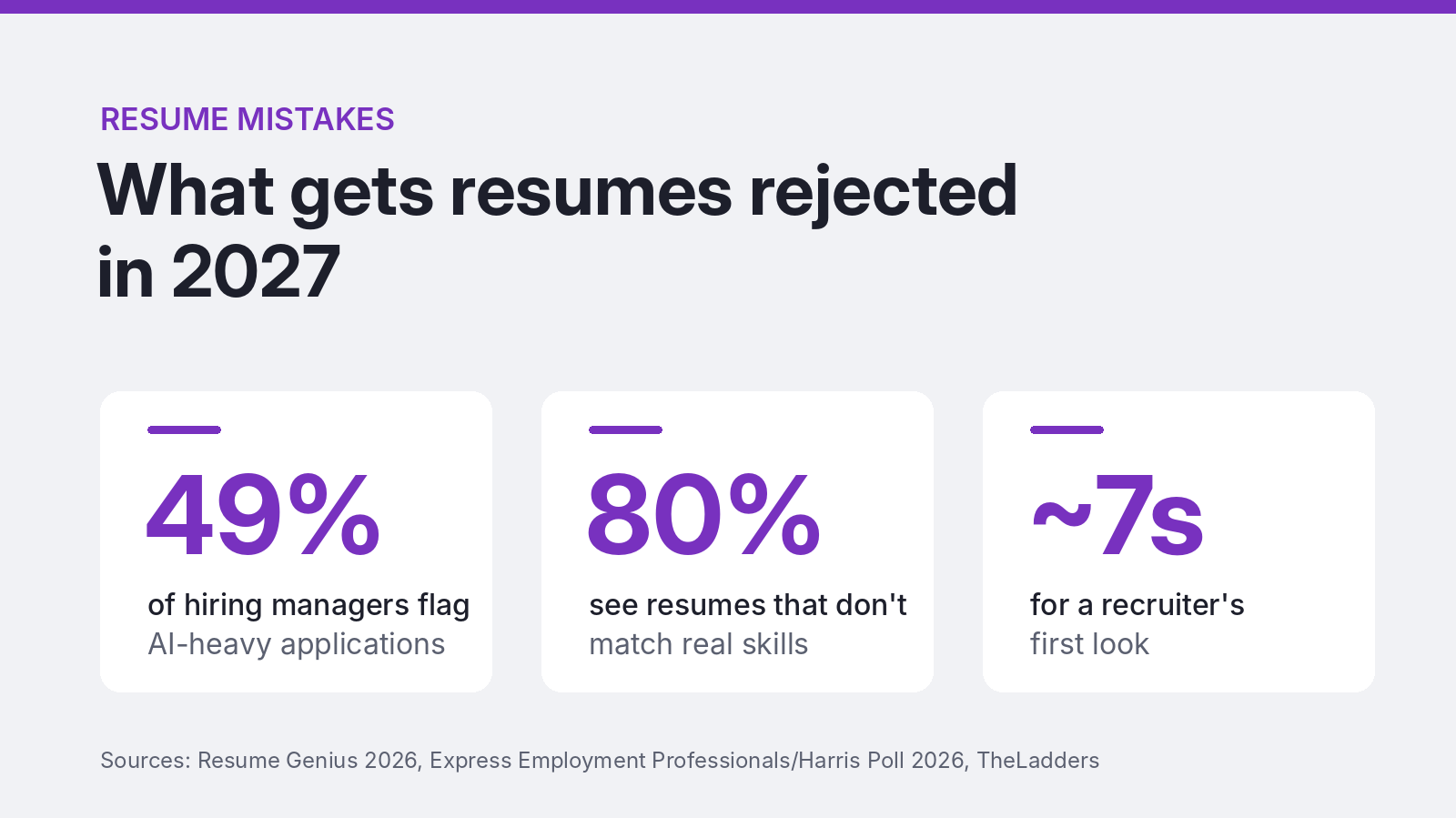
The first look is very short. TheLadders’ eye-tracking research found recruiters give a resume only a few seconds on the first pass, around 6 to 7 seconds, and spend most of that time on your name, current and previous job titles, employers and dates. That glance decides whether your resume gets a proper read. If it does, recruiters will spend minutes on it, not seconds.
Software rarely rejects you on its own. You may have heard that “75% of resumes are rejected by an ATS before a human sees them.” That figure traces back to a 2012 sales pitch from a resume company that has since shut down, and it has never been backed by published research. In practice, an applicant tracking system stores, parses and ranks applications, and recruiters search and filter them. Your resume is far more likely to be lost in the pile, or passed over by a person, than deleted by a bot. That changes what you should worry about.
1. Sending a generic, AI-written resume
This is now the biggest resume mistake. AI tools make it easy to produce a polished resume in seconds, and that is exactly the problem: they all sound the same. Resume Genius’s 2026 Hiring Trends Report, a survey of 1,500 US hiring managers, found heavily AI-generated application materials are now the second-biggest red flag, cited by 49%. A separate Resume Genius survey found 80% of hiring managers say they can spot an AI-written resume.
Resume writers see the same shift. In a Kickresume survey, 63% said generic, boilerplate content is now the most common resume problem, while only 8% said typos.
The fix: use AI for a first draft if you like, then rewrite it in your own words. Cut stock phrases like “results-driven professional” and “proven track record”, and replace them with specific things you did. Tailor the top third of the resume to each job.
2. Exaggerating skills or experience
Employers are more wary than ever. An Express Employment Professionals and Harris Poll survey found 80% of US hiring managers say resumes fail to match candidates’ real skills at least some of the time, and 86% believe AI makes it too easy to embellish a resume. In a resume.io survey, 21.5% of job seekers admitted lying on their resume in the past year, most often by inflating a job title or overstating a skill.
The fix: only list skills you could demonstrate in an interview or a skills test. Many employers now use assessments and structured interviews to check, so an exaggeration usually gets found out, just later and more awkwardly.
3. Typos and careless errors
Spellcheck and AI have made typos rarer, but they still sink applications. In a 2026 Jobera survey of recruiters, 58% called typos and grammar errors a red flag, the most-cited problem in the study. A misspelled company name or a wrong date suggests you rushed the application.
The fix: read the resume aloud, check every employer name and date, and have someone else look at it. Save it as a PDF and open the file to make sure the formatting survived.
4. Listing duties instead of results
“Responsible for managing social media accounts” tells a recruiter what the job was, not how well you did it. Duties are the same for everyone who held that title. Results are what separate you.
The fix: start each bullet with what you achieved and add a number where you can: “Grew Instagram followers from 4,000 to 25,000 in a year” or “Cut time to hire from 45 to 30 days by introducing structured interviews.” If you can’t measure it, describe the outcome.
5. Burying the information recruiters look for first
If a recruiter has to hunt for your current title, employer or dates, the first pass is over before it starts. Long personal statements at the top, creative layouts and skill bars push that information down the page.
The fix: keep a clear reverse-chronological layout. Put job title, employer and dates on one line for each role, and keep any summary to two or three lines that match the job you are applying for.
6. Formatting that confuses the ATS
An ATS may not reject you, but it does have to read your resume. Text in images, headers and footers, multi-column layouts and complex tables can come out scrambled, which means your details land in the wrong fields and you don’t show up when a recruiter searches for the right skills or title.
The fix: use a simple single-column layout, standard section headings (“Experience”, “Education”, “Skills”) and a standard font. A text-based PDF or Word file is fine for most systems unless the job ad says otherwise.
7. Keyword stuffing and “hacks”
Some candidates paste the whole job description into white text, or repeat keywords dozens of times. Recruiters see the parsed text, so hidden keywords show up in plain view and look like a trick. Stuffing also makes the resume harder to read for the human who decides.
The fix: mirror the job ad’s language naturally. If the role says “talent acquisition” and you wrote “recruitment”, use their term. Include the main skills and tools the ad asks for, where they genuinely apply.
8. Leaving gaps or short stints unexplained
Job-hopping is still the leading red flag for hiring managers, cited by 65% in Resume Genius’s 2026 survey, and employment gaps worry many recruiters too. Often the problem isn’t the gap itself but the lack of any explanation.
The fix: add a short line for gaps (“Career break: caring for a family member” or “Freelance projects”) and group short contracts under one heading. Don’t fudge dates; background checks will catch it.
9. Making it too long, or too old
Every line you add makes the important lines harder to find. Detailed bullets for jobs from 15 or 20 years ago rarely help.
The fix: one page for early-career candidates, two pages for most experienced ones. Give recent roles the most space and summarize older ones in a line each.
10. Using the same resume for every job
Applying to hundreds of jobs with one resume feels efficient, but recruiters are wading through a flood of exactly those applications. A resume that clearly matches the role stands out because so few do.
The fix: apply to fewer jobs and tailor each application: the job title in your summary, the most relevant achievements first, and the skills the ad emphasizes. Ten tailored applications usually beat a hundred generic ones.
11. Weak or missing contact details
An outdated email address, a missing phone number or a broken LinkedIn link creates friction at the exact moment a recruiter wants to reach you.
The fix: use a simple, professional email address, a phone number you answer, your city and state, and a LinkedIn URL that matches what your resume says.
What not to put on a resume
For US jobs, leave these off:
- A photo, date of birth or marital status
- Your full street address (city and state is enough)
- Salary history or current pay
- “References available on request”
- Reasons for leaving each job
- Hobbies that say nothing about how you work
- Skill ratings, charts or “proficiency bars”
A quick resume checklist
- Your current title, employer and dates can be found in under five seconds.
- Every bullet shows a result, not just a duty.
- The summary and top achievements match this specific job.
- It reads like you wrote it, with no stock AI phrases.
- Every skill listed is one you could prove in an interview.
- Single column, standard headings, no text in images.
- Proofread, with names and dates double-checked.
The bigger picture is that resumes are becoming one input among several. More employers are adding skills tests, work samples and AI-led first interviews, which you can read about in our piece on how AI and skills-based hiring are changing the resume. A clear, honest, tailored resume still gets you to those stages.
FAQ
What is the most common resume mistake?
Today it is generic content. With so many candidates using AI, resumes increasingly sound alike, and hiring managers rank heavily AI-generated applications among their top red flags. Typos are still a problem, but much less common than they used to be.
Do applicant tracking systems reject 75% of resumes?
No. The figure comes from a 2012 sales pitch and has no published research behind it. Most ATS platforms store and rank applications for recruiters to search and review. Knockout questions set by the employer, such as work authorization, can screen people out, but that is the employer’s rule, not the software judging your resume.
Is it OK to use AI to write my resume?
Yes, as a starting point. Use it to structure your experience or tighten wording, then rewrite in your own voice, add specific results and check every claim is accurate.
How long should a resume be?
One page if you have less than about ten years of experience, two pages for most experienced professionals. Academic and some technical roles can run longer.


