

Hiring someone costs far more than their salary. Before they start, you pay to find them. Once they start, you pay payroll taxes, benefits and the time it takes them to get up to speed. And if the hire doesn’t work out, you pay most of it again.
This guide breaks down the true cost of hiring an employee in the US in 2027, using the latest data from SHRM, the Bureau of Labor Statistics and recruiting benchmark reports, with a worked example you can adapt to your own roles.
The cost of hiring at a glance
| Cost | Typical figure | Source |
|---|---|---|
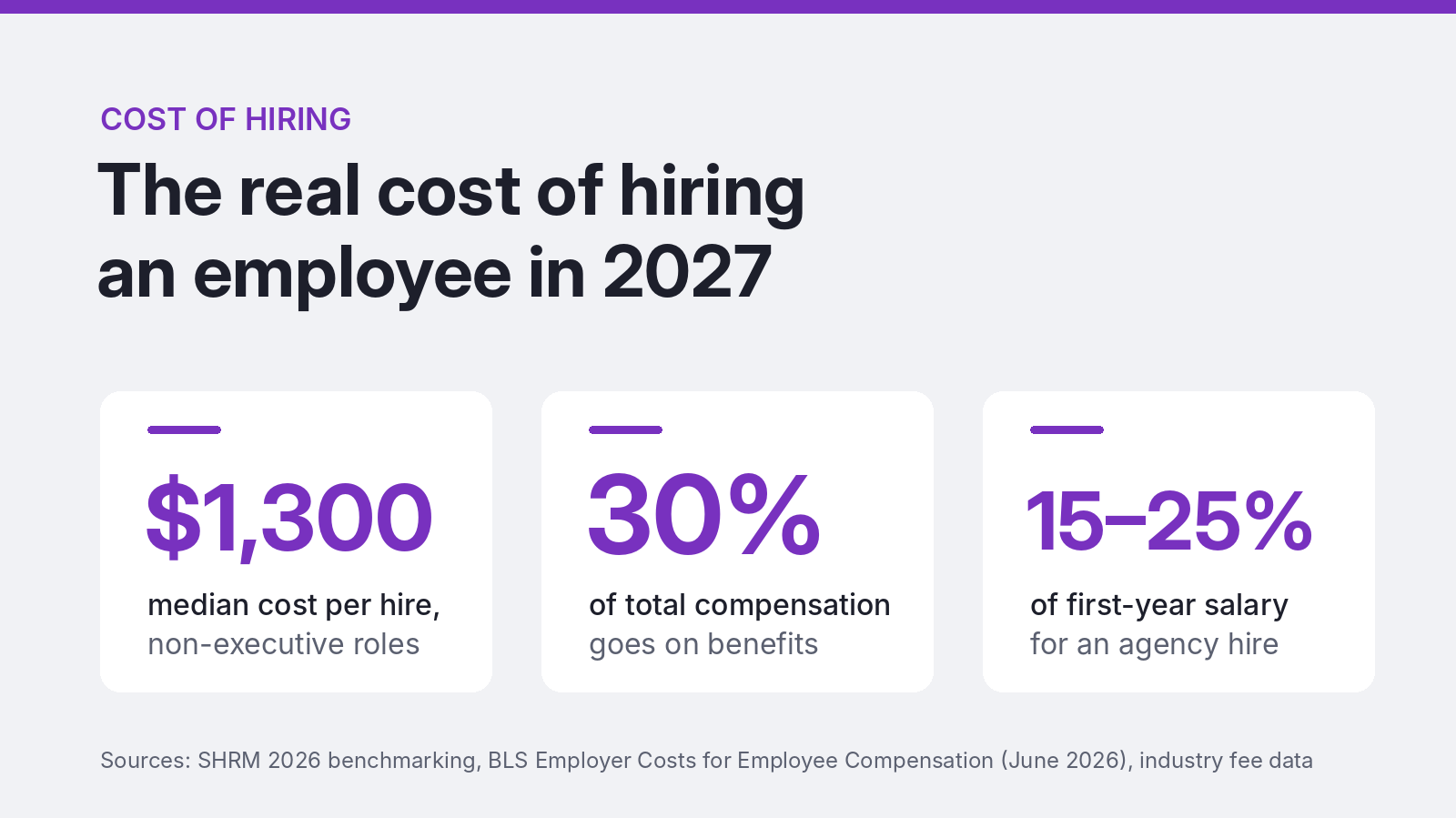
| Median cost per hire, non-executive (2026) | $1,300 | SHRM |
| Median cost per hire, executive (2026) | $15,000 | SHRM |
| Average cost per hire, non-executive (2025) | $5,475 | SHRM |
| Average cost per hire, executive (2025) | $35,879 | SHRM |
| Benefits as a share of total compensation | About 30% | BLS (June 2026) |
| Employer payroll taxes (Social Security and Medicare) | 7.65% of wages | IRS / SSA |
| Contingency recruitment agency fee | 15–25% of first-year salary | Industry standard |
| Average time to fill a role (2026) | 62 days | Greenhouse |
| Average cost of a bad hire | $14,900 | CareerBuilder |
1. Cost per hire: what you spend to fill a role
Cost per hire is the standard way to measure recruiting spend. The SHRM/ANSI standard calculates it as your external recruiting costs plus internal recruiting costs, divided by the number of hires in the period.
SHRM’s 2026 benchmarking puts the median cost per hire at $1,300 for non-executive roles, up slightly from $1,200 in 2025, and $15,000 for executive roles, up sharply from $10,600 in 2025. SHRM’s 2025 survey put the averages much higher, at $5,475 for non-executive hires and $35,879 for executives. The gap between median and average tells you that most hires are cheap to fill, but a minority of hard-to-fill roles cost a great deal.
Advertising is getting more expensive too. Appcast’s 2026 Recruitment Marketing Benchmark Report found the median cost per application rose 26% year over year, even in a cooler job market.
External recruiting costs
- Job advertising: paid job board listings, sponsored posts and programmatic ads.
- Agency fees: contingency recruiters typically charge 15% to 25% of first-year base salary, and retained executive search firms around a third of first-year cash compensation.
- Screening: background checks, drug tests and skills assessments.
- Technology: your applicant tracking system, sourcing tools, scheduling and assessment software.
- Travel, relocation and sign-on bonuses where they apply.
Internal recruiting costs
- Recruiter time: salaries and overheads for your talent acquisition team. SHRM found requisitions per recruiter rose 67% at extra-large organizations in 2026, so each recruiter is carrying more roles.
- Interviewer time: often the biggest hidden cost. Gem’s 2026 benchmarks counted around 20 interviews per non-technical hire and about 36 per technical hire. Multiply that by the hourly cost of your managers and engineers.
- Admin: scheduling, offer letters, paperwork and onboarding setup.
2. The cost of employing someone, beyond salary
Salary is only part of what an employee costs. According to the Bureau of Labor Statistics, private-sector employers spent an average of $46.89 per hour worked on compensation in June 2026: $32.82 in wages and salaries and $14.07 in benefits. Benefits made up about 30% of total compensation. For full-time workers, the total was $54.00 per hour, with benefits at 31.5%.
Put another way, for every $1 of wages, the average private employer spends roughly another 43 cents on benefits and legally required costs.
Payroll taxes every employer pays
- Social Security: 6.2% of wages, up to the annual wage base. That base is $184,500 in 2026 and rises to $192,300 in 2027.
- Medicare: 1.45% of all wages, with no cap.
- Federal unemployment (FUTA): 6.0% on the first $7,000 of each employee’s wages, usually reduced to 0.6% (or $42 a year) by the credit for paying state unemployment tax.
- State unemployment (SUTA) and workers’ compensation: rates vary by state, industry and claims history.
Benefits
Health insurance is usually the largest benefit cost, followed by paid leave and retirement contributions. These vary widely by employer size and plan, which is why the BLS averages are a better starting point than a single rule of thumb.
3. A worked example: hiring at $70,000
Here is a rough first-year cost for a mid-level hire on a $70,000 salary. Your figures will differ, so swap in your own.
| Item | In-house hire | Agency hire |
|---|---|---|
| Salary | $70,000 | $70,000 |
| Social Security, Medicare and FUTA | $5,397 | $5,397 |
| Benefits and other employer costs (BLS average ratio, less payroll taxes) | About $24,600 | About $24,600 |
| Recruiting cost | $5,475 (SHRM average) | $14,000 (20% agency fee) |
| Estimated first-year cost | About $105,500 | About $114,000 |
That is before onboarding, equipment and the months it takes a new hire to reach full productivity, when you are paying a full salary for partial output. As a rule of thumb, budget for total first-year costs of around 1.5 times base salary for a typical professional hire.
4. The cost of an empty seat
Every day a role stays open has a cost too: lost output, overtime for the rest of the team, missed revenue and slower projects. Greenhouse data puts the average time to fill a role at 62 days in 2026, and a third of openings go unfilled altogether. For revenue-generating roles such as sales, the cost of vacancy can easily outweigh the cost of hiring.
5. The cost of a bad hire
The most expensive hire is the wrong one. In a CareerBuilder survey of more than 2,000 US hiring managers and HR professionals, 74% said they had hired the wrong person for a role, and those employers lost an average of $14,900 on each bad hire. The real cost depends heavily on the role: senior and specialist mis-hires cost far more.
A bad hire costs you in several ways:
- The recruiting cost, paid twice when you replace them. SHRM found 97% of non-executive roles are now filled externally, so replacements rarely come cheaply from inside.
- Salary and benefits paid while performance was poor.
- Manager time spent on coaching, performance management and exit.
- Lower team morale and, in client-facing roles, lost business.
6. How to lower your cost of hiring
The cheapest savings usually come from better process, not cheaper tools.
- Use free and owned channels first. Your careers site, employee referrals and free job posting sites cost little and often produce better hires. Ashby’s data shows referred candidates pass the first screen at 52%, against about 35% for all candidates.
- Get your applicant tracking in order. A good applicant tracking system cuts admin, keeps every candidate in one place and shows you which channels actually produce hires, so you can stop paying for the ones that don’t.
- Cut interviewer hours. Fewer, structured interviews with clear scorecards save expensive manager time and make better decisions. Interview scheduling software removes the back-and-forth.
- Build a talent pool. Keeping in touch with strong candidates you didn’t hire makes the next search faster. A recruitment CRM helps if you hire for the same roles repeatedly.
- Automate high-volume roles. For hourly and frontline hiring, high-volume hiring software can handle screening and scheduling by text, which cuts both cost and time to fill.
- Use agencies selectively. Save agency fees for hard-to-fill or confidential roles, and negotiate the percentage and the replacement guarantee.
- Reduce bad hires. Skills assessments, structured interviews and proper reference checks cost far less than a mis-hire.
Hiring your first employee: what to budget for
If you are a small business hiring for the first time, plan for these one-off and ongoing costs on top of salary:
- An Employer Identification Number (EIN) from the IRS and registration with your state for unemployment tax and withholding
- Workers’ compensation insurance, which is required in most states
- Payroll software or a payroll provider to handle withholding and filings
- Employer payroll taxes of at least 7.65% of wages, plus FUTA and state unemployment tax
- Any benefits you offer, and equipment such as a laptop and software licenses
Rules vary by state, so check with your state labor department or an accountant before your first payroll.
FAQ
How much does it cost to hire a new employee?
SHRM puts the median cost per hire at $1,300 for non-executive roles and $15,000 for executives in 2026, with averages of $5,475 and $35,879 in 2025. Once you add payroll taxes and benefits, a typical professional hire costs around 1.5 times their salary in the first year.
How much does an employee cost on top of salary?
BLS data shows benefits make up about 30% of total compensation for private-sector workers, which works out to roughly 43 cents on top of every dollar of wages. That includes payroll taxes, insurance, paid leave and retirement contributions.
What is included in recruitment costs?
External costs such as job ads, agency fees, background checks and recruiting software, plus internal costs such as recruiter salaries and the time hiring managers and interviewers spend on the process.
How much do recruitment agencies charge?
Contingency agencies typically charge 15% to 25% of the hire’s first-year base salary, paid only if you hire their candidate. Retained executive search usually costs around a third of first-year cash compensation.


